How NextGen Women Are Reimagining Agriculture in Senegal

Across Senegal, women make up 70% of the agricultural workforce and produce 80% of the nation’s food, yet they continue to face major barriers to land, education, and finance. Globally, the potential is just as stark: FAO estimates that if women had the same access to resources as men, they could boost farm yields by 20–30%, cutting global hunger by up to 17%.
In our latest blog, Heifer International, a global nonprofit working to end hunger and poverty by supporting smallholder farmers with training, tools, and market access, shares the story of Anta, a young Senegalese woman who is transforming agriculture with grit, innovation, and a bold vision for the future.
We’ll be exploring how to reshape our food systems to be more inclusive of women and youth at this year’s Africa Food Systems Forum Summit 2025.
+++
The midday sun beats down on Anta Sarr’s field in Ngounjane, in the sleepy Thiès region of Senegal. She stands unfazed, a freshly picked eggplant in her hand – a symbol of resilience, innovation, and hope. At just 23, Anta represents a new generation of agricultural entrepreneurs challenging everything her community thought they knew about farming and women’s potential.
“We move forward because we have skills, passion, and a belief in our potential,” she says, her eyes scanning the abundant rows of vegetables. It’s a far cry from the path most young people in her region choose – many opt to leave, seeing agriculture as a dead-end profession. But Anta and her four fellow female farmers see something different: a revolution waiting to happen.
Their journey began with 21 young farmers – boys and girls with dreams of transforming their lives. Slowly, the group dwindled. The boys left, discouraged by the challenges. But the women stayed, forming an association they named TAKKU LIGUÈYE – “working together to build the community.”
Coming from vulnerable families, Anta and her colleagues – Fatou and Nogaye – refused to be defined by their circumstances. After initial training in Dakar, they were loaned a two-hectare field by their training director – a lifeline that would become their canvas of transformation.
“Agriculture without modernisation is agriculture without profit,” Anta declares passionately. This philosophy led them to embrace technology that many in their community view with scepticism. A solar-powered drip irrigation system now waters their crops – a small miracle in a region where manual labour has long been the only option.
The technological leap wasn’t just about efficiency. For these young women, it was also about dignity. “It’s too hard to operate hand-held watering cans,” Anta explains. “Those methods are archaic. We want to show that agriculture can be smart, profitable, and empowering.”
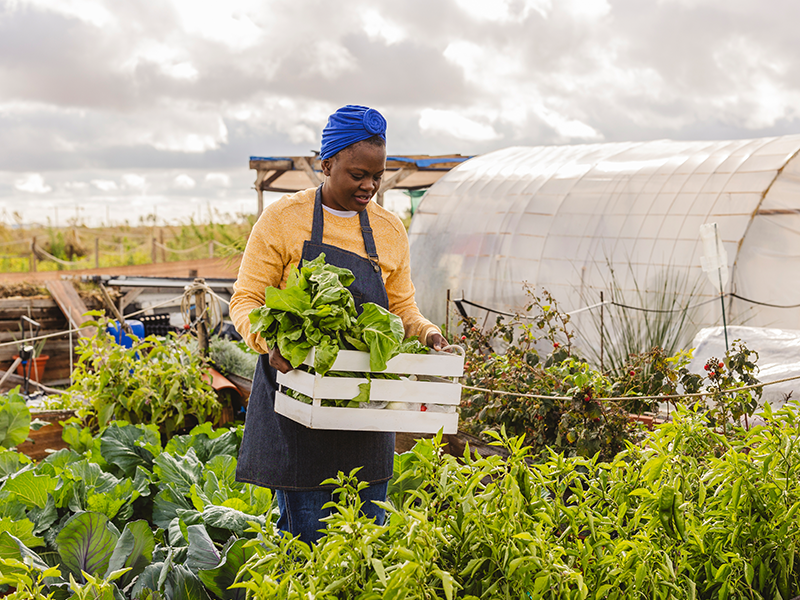
Their field tells a story of innovation. Eggplants of various sizes hang from flourishing plants, a testament to their skill and determination. They’ve cultivated not just vegetables, but a vision of what’s possible when young women are given resources and support.
Heifer International and the ARLS cooperative became crucial partners in their journey. Through their Climate Services for improved Resilience and Productivity (CSRP) project, they provided Anta and her mates not just seeds and equipment, but something more valuable; belief in their potential. Technical supervision from agricultural experts like Aissata Ka and Lamine Sow gave them the confidence to dream bigger.
Beyond self; empowering community
The AYuTe Africa Challenge, an annual competition by Heifer International that awards cash grants and mentorship to young innovators creating meaningful impact for smallholder farmers, became another source of inspiration for Anta and others. It encouraged them to begin to see themselves as more than just farmers – but as entrepreneurs, innovators, and changemakers.
Their immediate goal is practical: save profits to buy their own land and equipment. But their broader vision is transformative. “We want to help our parents, our community,” Anta says. “We want to show that young women can be self-sufficient and can create opportunity where others see only limitation.”
The challenges remain significant. Access to finance, modern equipment, and land are still major hurdles, especially for young women. But Anta sees these as challenges to overcome, not barriers to stop her.
“There is room for hope,” she says, a smile breaking across her face as she looks over her field. Each eggplant, each pepper, each innovation is a statement – about women’s capabilities, about agriculture’s potential, about reimagining development from the ground up.
In Ngounjane, and increasingly across Senegal, young women like Anta are planting more than just crops. They’re planting a future where technology, passion, and determination can grow anything – even opportunity.
As the sun begins to set over her field, Anta Sarr stands tall – not just as a farmer, but as a beacon of hope for young people, particularly women, in Senegal.
—