How a continental initiative launched in Paris is finding institutional resonance in Egypt
When the African Agrivoltaics Platform Initiative was launched in Paris on 10 April 2026, I attended the event online from Cairo. For me, it was not the beginning of a new interest. It was a moment of recognition. I saw the connection to a journey I had started nearly two decades earlier in Egypt, when climate action was still a marginal conversation and renewable energy was a topic few people were willing to discuss seriously.
The launch felt less like a beginning and more like a bridge.
A journey that began in 2007
In 2007, I founded the Egyptian Association for Scientific and Environmental Research. At the time, climate awareness in Egypt was fragmented. Discussions about greenhouse gas reduction, energy efficiency, and photovoltaic technologies rarely reached beyond scientific conferences.
We designed public awareness programmes on reducing global warming drivers, on household-level energy efficiency, on environmentally responsible lighting, and on the potential of solar energy for a country blessed with year-round sunshine. These programmes were built with the United Nations Development Programme, the Ministry of Environment, and the Ministry of Electricity. Over years, this work shaped a trajectory that would later cross into governance, quality management, international standards, and climate finance.
None of it felt like preparation for agrivoltaics at the time. In retrospect, it was.
What the AAPI launch made visible
The AAPI launch carried a different message. It was not asking whether Africa should invest in solar energy. It was asking how the continent could turn agrivoltaics, the integration of solar photovoltaics with agricultural production, into a viable investment-ready market.
The Consortium for Sustainable Agrivoltaics, C4SA, framed the challenge with clarity. Building solar systems on farms is a technology question. Creating the institutional conditions that allow an agrivoltaics market to emerge is a governance question.
The distinction matters. Because the technology is largely available. The governance is not.
From continental vision to national action
That framing gave shape to a question I had been sitting with for years: how could this continental model be translated into national reality in Egypt? The Egyptian Agrivoltaics Initiative, EAI, was our answer. Founded in April 2026, EAI approaches agrivoltaics not as a solar-plus-agriculture engineering project, but as an institutional and market-readiness challenge that connects governance, ESG, climate finance, farmers, regulators, and investors within a single coordination architecture.
The initiative operates independently, publishes its research openly with permanent identifiers on Zenodo, and coordinates with international partners through its participation in AAPI’s Working Group 1 on evidence and capacity building, and Working Group 2 on finance and investment. Having actively contributed to co-authoring the African Agrivoltaics Handbook, we focused on institutional frameworks that translate blended finance and capacity building from high-level policy into site-level implementation.
What is beginning to move
Egypt has excellent physical conditions for agrivoltaics. Strong solar irradiation. Agricultural land under active planning. Government interest in food security and renewable energy transition. What has been missing is the institutional layer that connects these elements to investment capital.
What is happening now is a set of concrete institutional movements:
- Institutional Dialogue. Direct outreach has been initiated with relevant Egyptian institutional stakeholders, exploring pathways toward a national agrivoltaics framework.
- Governance-Ready Frameworks. Actionable frameworks have been developed to align renewable energy transition with agricultural climate resilience, ready for institutional adoption.
- Standardization Pathway. A formal proposal has been submitted to the Egyptian Organization for Standardization and Quality (EOS) requesting formation of a technical working group to develop the first Egyptian national strategy for agrivoltaics, potentially among the first on the continent. The proposal is grounded in three published research papers positioning the Hafez Governance Framework as its scientific foundation.
This work is early. Its outcomes will depend on decisions that remain sovereign, including policy and regulatory conditions to convince farmers and private investors to embrace agrivoltaics. But the direction is clear, and the conversation has started.
Why this matters for Africa
Egypt is one example of a wider African pathway. The AAPI model was not designed to require every country to follow an identical institutional structure. It was designed to be adapted and adjusted across national contexts, each responding to its own political economy, its own land governance, and its own agricultural and energy priorities.
If the model works in Egypt, it can work elsewhere. Not by imitation, but by adaptation.
A call to action
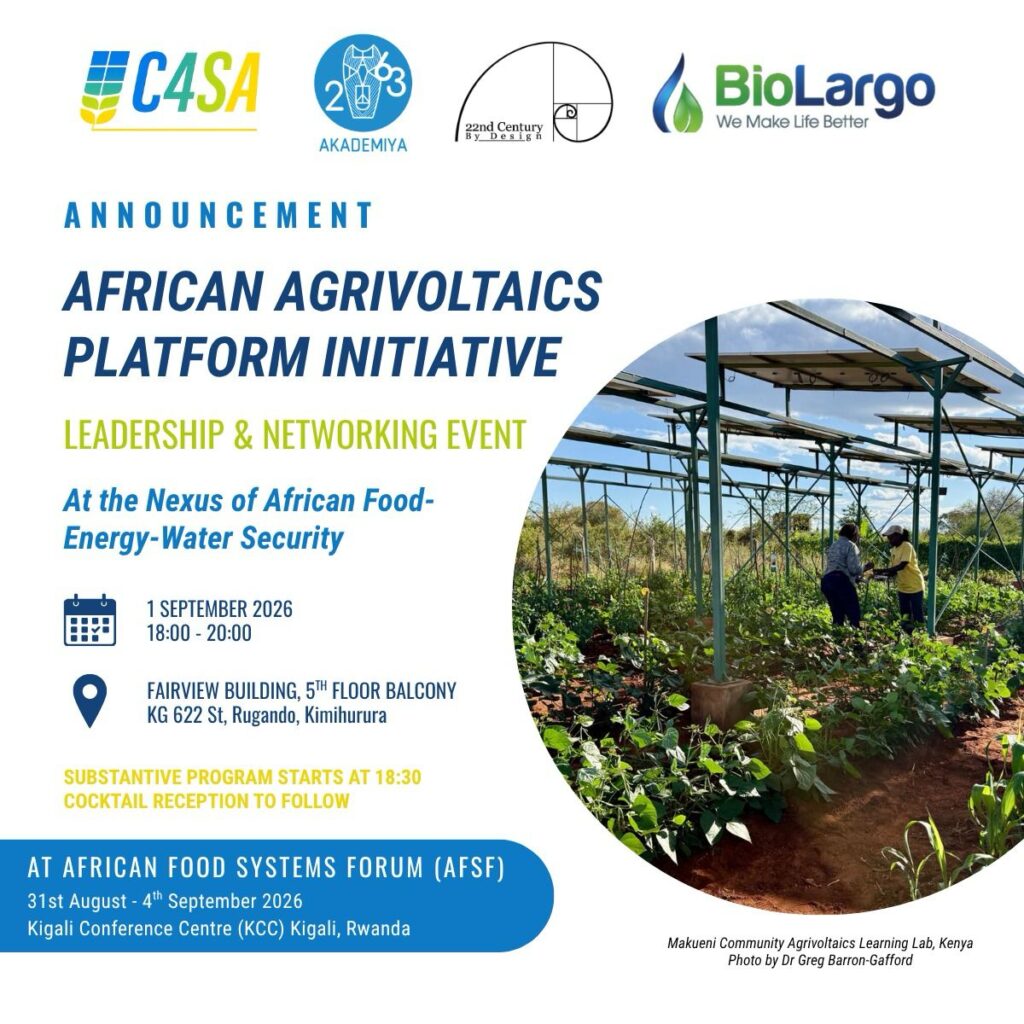
The launch of AAPI in Paris was not the end of a conversation. It was the birth of a mechanism for turning interest into national action. The September 1 event in Kigali is meant to foster such action.
For this mechanism to work, governments need to engage. Farmers must be part of the design, not an afterthought. Banks and investors need clarity on what constitutes an investible project. Regulators need frameworks that give them confidence. Countries must adapt the model to their own conditions.
Africa does not lack interest in agrivoltaics. What it needs now is the institutional readiness to turn that interest into viable markets.
That readiness will not build itself.
https://www.facebook.com/EASRE.NGO/photos?locale=ar_AR
