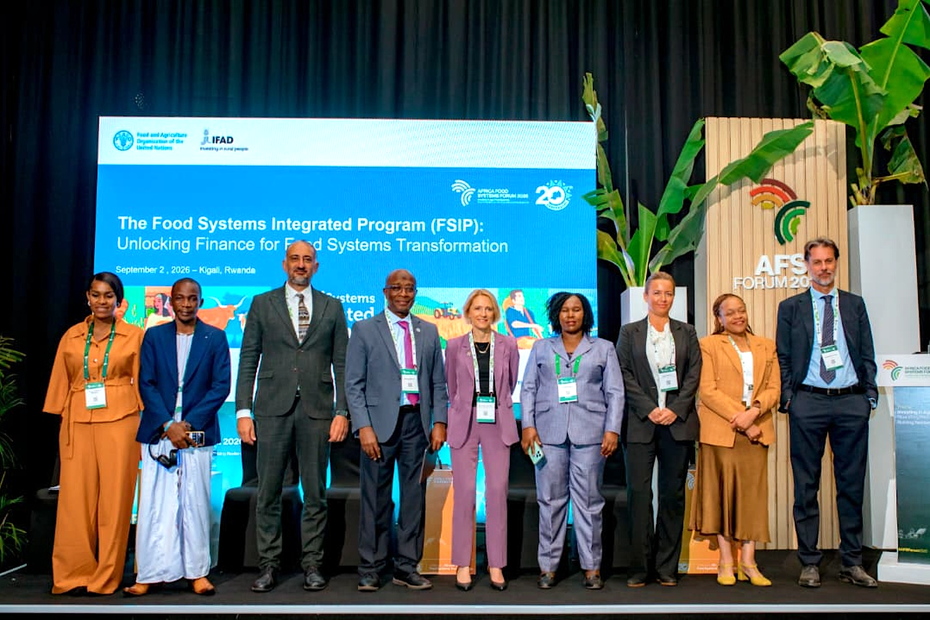
At a GEF-supported Food Systems Integrated Program (FSIP) event held during the Africa Food Systems Forum (AFSF) 2026 in Kigali, governments, financial institutions and practitioners explored how countries can mobilize the partnerships, expertise and finance needed for food-systems transformation. The discussion highlighted FSIP as a practical model for turning national priorities into integrated investments that benefit people, nature and climate.
Bringing Food Systems Transformation from Ambition to Investment
Africa’s food systems are increasingly challenged by climate shocks, land degradation, biodiversity loss and food insecurity, while governments face growing demands to create jobs, improve livelihoods and strengthen resilience. Addressing these interconnected challenges requires more than individual projects or isolated financing streams. It requires integrated approaches that connect environmental sustainability, agricultural productivity and economic opportunity.
These issues framed the GEF-led Africa Food Systems Forum session titled “Food Systems Integrated Program: Unlocking Finance for Food Systems Transformation”, held in Kigali, Rwanda. The Food Systems Integrated Program led by the Food and Agriculture Organization of the United Nations (FAO) and the International Fund for Agricultural Development (IFAD) and supported by the Global Environment Facility (GEF) aims to catalyze the transformation to sustainable, resilient and inclusive systems across 32 countries.
The FSIP event highlighted GEF’s global environmental mandate and impact, as well as the complementary roles of FAO and IFAD in connecting policy, technical support and the private sector. The discussion underscored a connected pathway for food systems transformation: country priorities set the direction; policy shapes the conditions and incentives for investment; technical support clarifies feasible solutions; partnerships with private-sector actors help develop credible opportunities; finance and de-risking mechanisms help mobilize investment; and learning strengthens future decisions.
This logic emphasized the importance of programmes that work through existing institutions and national plans while expanding access to finance. Catalytic support is most valuable when it helps countries make informed choices, align partners and create the conditions for investment to reach producers, rural enterprises and the landscapes on which they depend.
Building an Integrated Platform for Food Systems Transformation
The event was facilitated by Nevena Bakalar, Knowledge Management and Partnerships Focal Point, Global Coordination Project, FSIP-IFAD, who framed the exchange around connecting country-led priorities with the finance, partnerships and investment pathways needed to advance food systems transformation. Tadeo Ajuna, Programme Coordinator at YPARD, supported the dialogue by bringing youth voices into the discussion.
Opening the substantive discussion, Dr. Mohamed Bakarr, Manager of the Integration and Knowledge Division at the GEF, placed FSIP within the broader effort to connect environmental objectives with development outcomes.
Dr. Bakarr’s intervention emphasized that food security, climate action, biodiversity conservation and land restoration should not be treated as competing priorities. Instead, they are mutually reinforcing components of sustainable development that need to be addressed together through coordinated investments.

Dr Mohamed Bakarr, Manager of the Integration and Knowledge Division, GEF
This integrated perspective lies at the heart of FSIP. With 32 FSIP country projects globally, including 13 in Africa and US$283 million in GEF financing and the ambition to leverage approximately US$2 billion in co-financing, FSIP helps countries design and implement investments that address the interconnected challenges facing their food systems.
The GEF’s contribution creates a common investment logic across climate, biodiversity and land degradation, while allowing countries to define responses suited to their institutions, landscapes and markets. Within the GEF, Dr. Peter Umunay, Thematic Lead for Food Systems and Land Use, has helped carry this integrated approach through the institution’s food-systems portfolio, linking environmental ambition to the practical work of transforming production, value chains and rural livelihoods.
The programme also provides a practical pathway for advancing the objectives of the three Rio Conventions. By promoting climate-resilient production systems, sustainable land management, ecosystem restoration and biodiversity-positive value chains, FSIP helps countries pursue goals under the United Nations Framework Convention on Climate Change (UNFCCC), the Convention on Biological Diversity (CBD) and the United Nations Convention to Combat Desertification (UNCCD) through a common investment platform.
As reflected throughout the discussion, food systems sit at the intersection of climate, biodiversity and land challenges. FSIP demonstrates how investment strategies can generate multiple benefits across these agendas while simultaneously supporting food security, livelihoods and economic resilience.
Mobilizing the Finance Needed for Food Systems Transformation
Translating this integrated vision into action ultimately depends on finance – not only its scale, but also how effectively it is structured, de-risked and directed toward country priorities. This brought the discussion to one of the most significant barriers to food systems transformation. Sara Mbago-Bhunu, Director of IFAD’s East and Southern Africa Division, stressed that the scale of transformation required cannot be achieved through public financing alone. “Africa’s food systems transformation cannot be financed by the public sector alone.”
Ms. Mbago-Bhunu’s remarks also highlighted the catalytic role of public and concessional financing in helping to attract additional investment which is needed. “Public and concessional resources have a catalytic role in strengthening evidence, institutions, investment pipelines and risk-sharing arrangements, helping to attract responsible private investment while ensuring that rural communities remain included”, she said.
Under Ms. Mbago-Bhunu’s leadership, IFAD’s East and Southern Africa Division connects FSIP with IFAD country operations in Ethiopia, Kenya and Uganda, the three IFAD-led FSIP country projects, helping align support with national priorities and share lessons across the wider 32-country programme.
Ms. Mbago-Bhunu’s remarks also highlighted the value of the IFAD–GEF partnership. GEF resources can address environmental priorities that markets may overlook, while IFAD’s broader investment portfolio can connect them with rural development programmes, value chains and country institutions. The Upper Tana-Nairobi Water Fund illustrates this potential by bringing together environmental restoration, water security, agricultural productivity and public-private collaboration around shared economic interests. Together, these approaches can help translate environmental priorities into viable development and investment opportunities.

Sara Mbago-Bhunu, Director of IFAD’s East and Southern Africa Division
FSIP Linking Policy, Knowledge and Learning
The role of knowledge and institutional support was further explored by Corinna Hawkes, Director of FAO’s Agrifood Systems and Food Safety Division.
Ms. Hawkes’ intervention underscored that transforming food systems requires more than financing. It also requires learning, adaptation and collaboration across countries and stakeholders.
“A systemic approach to transformation requires stronger knowledge exchange, sharing of best practices and collaborative learning among countries and stakeholders” she said.
This perspective reflects an important dimension of FSIP. While country projects operate in different contexts, landscapes and value chains, they face many common challenges. Bringing together experiences across the portfolio helps identify what works, what can be scaled and how investments can deliver environmental, social and economic benefits over time.
FAO’s contribution to the FSIP focuses on exactly these areas: strengthening policy frameworks, technical capacities and knowledge systems to support systemic transformation and create enabling conditions for investment. Together FAO and IFAD respond to country priorities while generating shared learning on what makes food-system investments viable, scalable and environmentally sustainable across diverse contexts.

Corinna Hawkes, Director of FAO’s Agrifood Systems and Food Safety Division, speaking on policy, knowledge and collaborative learning.
Turning Programme Design into Country Action
Building on these themes, Massimo Giovanola, Co-Coordinator of the FSIP Global Coordination Project at IFAD, provided a closer look at how the programme operates in practice.
Mr. Giovanola’s presentation emphasized that country projects are at the center of FSIP. The programme’s role is not to impose a model, but to help countries identify priorities, develop partnerships and build investment pathways suited to their specific contexts.
IFAD’s contribution was highlighted including investment readiness, private-sector engagement, de-risking instruments, insurance solutions such as IFAD’s INSURED, and platforms such as Agri-PDB, alongside needs-based technical assistance and implementation support. IFAD’s financing and market-oriented focus within the FSIP complements FAO’s technical, policy and institutional work, enabling the two agencies to connect country priorities with the partnerships, risk-management tools and enabling conditions required to mobilize investment and advance food-systems transformation at scale.
Against this backdrop, implementation support is being organized to translate the programme architecture into coordinated, country-led action. In collaboration with national counterparts and partners, country teams are being supported to articulate priority needs across finance, markets and public/private sector partnerships; identify where technical assistance could address binding constraints; develop focused, investment-ready pipelines; and connect institutional relationships with practical services, market opportunities and financing decisions.

Massimo Giovanola, Co-Coordinator, FSIP-IFAD, and Nevena Bakalar, Knowledge Management and Partnerships Officer, FSIP-IFAD
Learning will form an integral part of this collaborative approach. FSIP’s portfolio can provide value not only by showcasing promising models, but also by documenting the conditions that enable their adaptation in different contexts, including how public resources supported de-risking, how policy and data gaps were addressed, how environmental outcomes were safeguarded, and how producers and rural enterprises participated in and benefited from the value created. These lessons can further strengthen the complementary contributions of FAO’s technical and policy support and IFAD’s expertise in finance, markets and partnerships, helping inform context-responsive approaches to food-systems transformation.
Ensuring Food Systems Transformation Is Inclusive
The event also emphasized the importance of ensuring that food-systems transformation creates opportunities for those most directly affected by it.
Clara Kamlomo, Founder and Chief Executive Officer of Amazing B Projects Limited in Malawi, provided a powerful example from the perspective of a young entrepreneur.
Drawing on her experience with IFAD-supported initiatives, she emphasized the importance of enabling young women to participate not simply as programme beneficiaries but as business owners, innovators and job creators.
Her intervention reinforced a broader message echoed throughout the event: successful food-systems transformation depends on the ability of farmers, entrepreneurs, women and young people to access finance, technology, knowledge and markets. Investments are more likely to be sustainable when local actors are empowered to shape and benefit from new opportunities.
FSIP in Action: Lessons from Kenya
The FSIP places country ownership at the center of its operating model. Rather than applying a single global solution, FSIP is intended to help countries connect their own priorities to the technical expertise, partnerships and finance needed to advance them. The African portfolio is therefore not only a collection of national projects; it is an opportunity to demonstrate how country-led, inclusive and nature-positive transformation can be made practical under real institutional and market conditions.
The programme’s practical application became particularly clear through country experiences shared during the session.
Dr. Selly Jemutai Kimosop, Environment Secretary at Kenya’s Ministry of Environment, Climate Change and Forestry, presented Kenya’s experience implementing the FSIP approach through the project Integrated Land and Water Management for Food, Water and Climate Security in the Dairy Food System.

Dr Selly Jemutai Kimosop, Environment Secretary in Kenya’s Ministry of Environment, Climate Change and Forestry
The initiative, led by IFAD, focuses on the Yala–Nyando watershed across Nandi, Kakamega and Kericho counties the project links dairy value-chain development with climate-smart production, sustainable land and water management, landscape restoration and green finance. With co-financing of nearly US$39 million, in addition to US$7.1 million in GEF-8 FSIP resources, the project combines climate-smart dairy production with sustainable land and water management, watershed restoration, producer support, market development and green finance.
Kenya’s experience illustrated how environmental restoration can be integrated into broader agricultural investment strategies. Rather than treating conservation and production as separate objectives, the project links landscape health directly to the long-term productivity and resilience of the dairy sector.
As Dr. Kimosop emphasized, responsible management of natural resources is not separate from economic development; it is essential to the long-term viability of livestock systems, producers and markets.
The example demonstrated how FSIP’s integrated approach can help countries connect environmental priorities with investment opportunities and rural economic development.
FSIP in Action: Lessons from Uganda
A second example came from Uganda.
Mohamed El-Ghazaly, IFAD Country Director for Uganda, presented the Resilient Livestock Value Chain Project (ReLIV), which is expected to benefit approximately 200,000 households across 41 cattle-corridor districts.
The project combines livestock productivity, animal health, water and pasture management, value addition, market access, youth employment and nutrition interventions. Through FSIP, these efforts are complemented by a broader landscape and climate perspective that recognizes the role of ecosystems and environmental risks in determining long-term development outcomes.
The programme is expected to strengthen Uganda’s dairy and beef sectors while improving market access and supporting a more enabling policy and regulatory environment. Gender, youth and climate-finance considerations are also integrated throughout implementation, with a focus on expanding opportunities for women and young people within livestock value chains.

Mohamed El-Ghazaly, IFAD Country Director, Uganda
Together, the experiences from Kenya and Uganda demonstrated that integration is not simply a concept. It is an implementation discipline that requires aligning production systems, landscapes, markets, institutions and financing arrangements around shared development objectives.
Moving from Dialogue to Delivery
The discussions in Kigali highlighted the growing recognition that food-systems transformation requires more than resources alone. It requires country leadership, integrated planning, strong partnerships, technical expertise and financing models capable of delivering multiple benefits across sectors.
FSIP was presented throughout the event as a platform designed to bring these elements together.
By combining the catalytic financing of the GEF with FAO’s technical and policy expertise, IFAD’s investment experience, and country-led implementation, the programme helps governments transform national priorities into practical investment pathways.
The experiences shared by Kenya and Uganda demonstrate what that can look like in practice. They show how integrated investments can simultaneously strengthen food security, enhance climate resilience, conserve biodiversity, restore landscapes and expand economic opportunities.
As implementation advances across Africa, the opportunity now is to build on these experiences, strengthen partnerships and develop the next generation of country-led investments. In doing so, FSIP can help turn food-systems ambition into coordinated action, and action into lasting benefits for people, nature and climate.
Prepared by
Nevena Bakalar
Knowledge Management and Partnerships Focal Point
FSIP-IFAD
