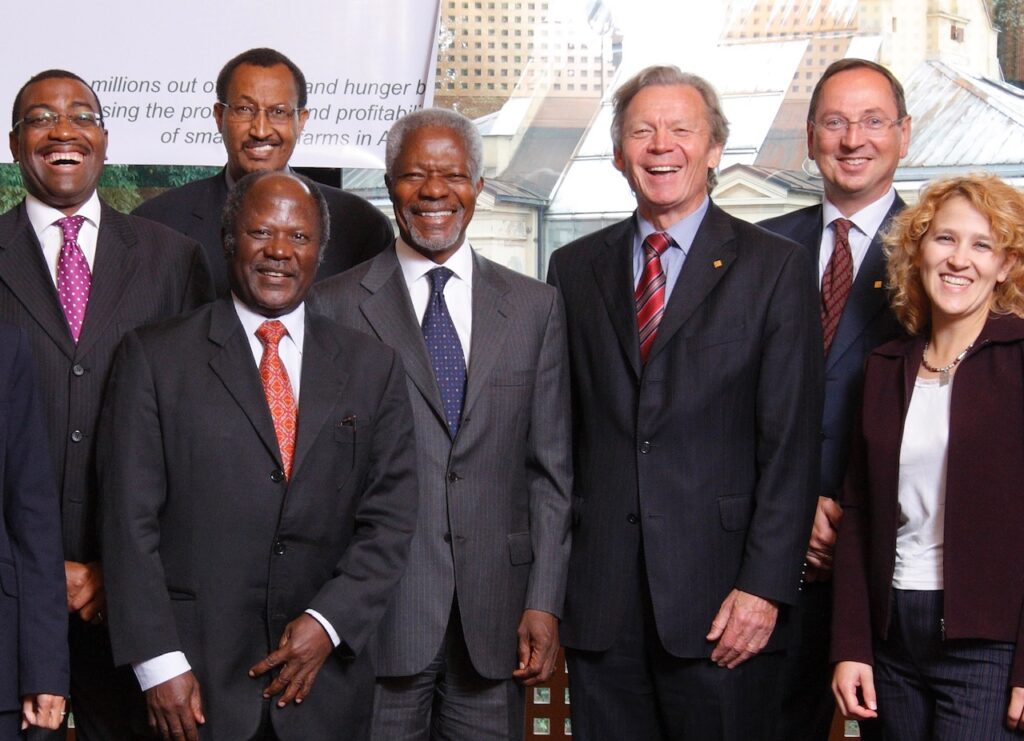
The early journey of the Yara Prize, the African Green Revolution Conference and the institutions they became – A narrative contribution by Arne Cartridge
The beginning was a call to action
The story began for me in Addis Ababa on 5 July 2004, at a high-level United Nations seminar convened immediately before the African Union Summit. I had been invited in my capacity at Yara. The meeting brought together African political leaders, scientists, development institutions, business and civil society around one stark question: why had Africa, unlike other regions, not yet experienced the agricultural transformation needed to overcome chronic hunger and rural poverty?
Kofi Annan and Jeffrey Sachs presented the work and emerging recommendations of the UN Millennium Project’s Hunger Task Force. The diagnosis was urgent, but the message was not one of resignation. Africa already possessed much of the knowledge required to act. What was missing was the political will, institutional capacity, investment and alignment needed to put that knowledge to work at scale. Annan called for a ‘uniquely African green revolution’—one that would be pro-poor, pro-women and environmentally responsible, and that Africans would shape and own.
That phrase stayed with me. It was both a moral challenge and a practical invitation. Yara was approaching its centennial in 2005. My conviction was that a hundredth anniversary should look forward rather than backward: it should be marked by a commitment connected to the company’s competence, history and responsibilities. I returned to Oslo and proposed to Yara’s President and CEO, Thorleif Enger, that responding to Annan’s call should become the cause at the heart of the centennial.
Thorleif understood the opportunity immediately. He supported taking the proposal to the Board, which approved it. That decision mattered. It moved the idea beyond a one-off anniversary gesture and gave Yara the mandate to explore what a serious, sustained contribution might look like. From the outset, the intention was not to create a corporate campaign around Yara. It was to help build a common good for Africa and its smallholder communities—something that could attract other actors, recognize African leadership and ultimately outgrow its original sponsor.
Listening before designing
We began by seeking advice from people who combined scientific authority with long experience of agricultural transformation: Norman Borlaug, Jeffrey Sachs and Pedro Sanchez. Their counsel reinforced several fundamentals. Agricultural transformation had to be grounded in science and improved productivity. Smallholders needed practical access to better seed, soil nutrients, water management and knowledge. Women, who carried much of the burden of African agriculture, needed to be placed at the centre. Government leadership was indispensable—but lasting transformation would also require functioning markets, viable local businesses and farmers receiving a fair return for what they produced.
The discussions also brought us into early contact with Akinwumi Adesina, then at the Rockefeller Foundation. Akin brought a powerful mix of economics, institutional imagination and impatience with business as usual. His work on agro-dealer networks made the market challenge tangible: productive technologies were of little value if they could not reach farmers, and rural input businesses could not grow without knowledge, finance and a supportive policy environment. These early relationships helped connect the emerging Yara initiative to a wider African and international community already working toward the same goal.
This listening phase established a principle that would shape both the Prize and the Forum: no single institution, sector or intervention could deliver an African agricultural transformation. The role of a company could be catalytic—to convene, contribute competence, take risk and build bridges—but the agenda itself had to be African, shared and bigger than any one organization.
The Yara Foundation and the Yara Prize: recognizing agency
Yara chose to organize the new commitment through the Yara Foundation for an African Green Revolution, established in 2005 as an independent Norwegian foundation with its own statutes and an international board. The Foundation’s arm’s-length structure was deliberate. It gave the work integrity beyond normal corporate decision-making while allowing it to draw on Yara’s agricultural competence, networks and long-term presence in Africa. Board members over the early years included African and international leaders from agriculture, science, development and public life, among them Pedro Sanchez.
The first expression of the commitment was the Yara Prize for a Green Revolution in Africa, launched and first awarded in 2005. Its purpose was not simply to reward technical achievement. It was to recognize people and institutions whose leadership could change the reality of farming and food security—and to make visible the African change agents too often absent from international narratives about hunger.
The laureates gave the ambition a human face. In 2006, the Prize recognized Fidelis Wainaina of Kenya and Celina Cossa of Mozambique. I remember visiting Fidelis outside Kisumu: her warmth, her determination and the way she connected agricultural self-reliance to dignity, community and opportunity for people made vulnerable by poverty and HIV/AIDS. Her work was a reminder that transformation does not begin only in ministries or research institutes. It also begins with trusted people in communities—often women—who put knowledge into practice and help others believe that change is possible.
The Prize therefore established one half of a larger proposition. Africa needed visible examples of leadership and achievement. But recognition alone could not remove the barriers faced by such leaders.
Their work also needed an enabling system: stronger policies, finance, science, infrastructure, markets and partnerships. That realization led naturally from an award to a convening platform.
From recognition to collective action: the Oslo conferences
In 2006, Yara convened the first African Green Revolution Conference in Oslo alongside the Prize. Its theme—‘Catalyst for Action’—captured the intent. The conference was designed as a neutral, high-level arena where African governments, farmer representatives, researchers, development agencies, civil society and business could meet across institutional boundaries. The purpose was not another general discussion about hunger. It was to build the relationships and practical partnerships required to turn an African-led agenda into action.
The sequence developed deliberately. The first conference in 2006 focused on catalysing action. The second, in 2007, focused on ‘Partnership for Productivity’. The third, in 2008, became an ‘Alliance for Action’. Across the three Oslo gatherings, a network took shape around a shared understanding: smallholder productivity had to rise, but productivity could not be separated from profitability; farming had to be treated as a business; and public policy, public investment and private enterprise had to work together across the agricultural value chain.
The conferences helped give public–private partnership a more concrete meaning. Better seed and fertilizer mattered, but so did rural finance, insurance, storage, transport, market information and reliable demand. Governments needed to create enabling conditions and invest in public goods. Businesses needed to see smallholders and local agribusinesses not merely as beneficiaries, but as customers, suppliers and entrepreneurs. Development partners and scientists needed to help de-risk innovation and build capacity. Farmers and their organizations needed a voice in shaping the solutions.
The 2007 Oslo Accord: a mandate to continue
A decisive milestone came at the second conference in 2007. A Ministerial and High-Level Roundtable brought together 18 African ministers of agriculture and finance, alongside leaders from business and public institutions. Moderated by Jeffrey Sachs, it translated the conference discussions into the Oslo Accord—also commonly referred to as the Oslo Declaration—and an eight-point Agenda for Action.
The Accord placed the work firmly within Africa’s own policy architecture, especially the Comprehensive Africa Agriculture Development Programme (CAADP) and the Maputo commitment to agricultural investment and growth. It called for increased access to technologies and finance for smallholders; stronger markets and price stability; appropriate risk-mitigation systems; regional approaches to fertilizer and input costs; and tools to monitor delivery. At its centre was a clear proposition: a uniquely African green revolution required ‘smart public-private partnerships’ and institutions capable of brokering them in line with African priorities.
The eighth action point became especially important for what followed. It called for the African Green Revolution Conference to continue as the forum for public–private partnership, supported by an ongoing communications platform that could document progress, highlight innovation and enable regular interaction among African ministers and other key stakeholders. The Forum was therefore not an idea imposed after the Oslo series. Its mandate emerged from the participants themselves.
The pivotal choice in 2008: move the centre of gravity to Africa
By 2008, the Oslo conferences had built recognition and trust, but they also faced a strategic choice. Some participants valued Oslo as a neutral meeting place. Others argued that a conference about African transformation had to be located and led on the continent. For Yara, the answer became clear: the next phase needed stronger African leadership, a broader partnership base and an institutional home that did not depend on Yara as its principal convener and funder.
Ahead of the third conference, I wrote to Akin Adesina with a proposal to launch an African Green Revolution Forum as the outcome of the 2008 gathering. The proposal envisaged an informal, independent and low-overhead platform based in Africa; jointly initiated by Yara, the Yara Foundation and AGRA, with NEPAD and other partners invited to participate; and balanced across public and private sectors, Africa and international partners, large companies and local enterprises, governments, civil society, farmer organizations and women.
During the 2008 conference, Yara and AGRA agreed to work together to move the platform to Africa. Kofi Annan, by then Chair of AGRA, provided vital continuity between the original 2004 call and the emerging African institution. Akin Adesina and I were mandated to develop the framework. Akin led from AGRA; I served as the key driver and executive producer, later leaving Yara and leading the independent secretariat responsible for developing and producing the Forum. The intent was to retain the quality and convening power built in Oslo while changing the locus of ownership.
This was a transfer by design. The platform was to become more than an annual event: a partnership forum with African leadership, a diverse group of strategic partners, an advisory network and professional secretariat support. The Prize would continue as a premier recognition event connected to the Forum, creating a powerful combination—celebrating the people already demonstrating what was possible while convening the institutions capable of taking such change to scale.
From Oslo to Accra: the Forum takes root
There was no instant institutional leap. The move required patient work: agreement on purpose and governance, consultations with African governments and partners, fundraising, programme development and the practical creation of a secretariat. The first African Green Revolution Forum was ultimately held in Accra, Ghana, in 2010, with more than 600 registered participants. It marked a decisive change from an Oslo conference series to an Africa-based platform focused on investment, political leadership, science, policy and action across agricultural value chains.
The 2010 Forum also sharpened a question that has remained relevant: how can a summit be different from a sequence of speeches? Its working sessions were framed around four practical questions—what needs to be done, who will do it, when it will be done and how progress will be monitored. Participants called for continuity, an annual rhythm and a secretariat that could function as a communications hub between summits. The ambition was for the Forum to become an ongoing partnership platform rather than a stand-alone event.
The governance proposals developed after Accra reflected the founding principle that the Forum should not be dependent on either Yara or AGRA alone. Strategic partners would provide direction and resources; an advisory community would bring in wider expertise; and a dedicated secretariat would maintain momentum and accountability. AGRA’s strategic leadership and African institutional base were indispensable. Yara remained committed as founding partner, catalyst and supporter, but the Forum’s legitimacy would come from its breadth and African ownership.
Two institutions, one founding logic
The Prize and the Forum subsequently evolved in name and scope, as they were intended to do. In 2016, the Yara Prize became the Africa Food Prize, with a distinct African home, identity and ownership, while Yara continued as a founding partner with AGRA. In 2022, the African Green Revolution Forum adopted the broader identity of the Africa Food Systems Forum, reflecting the shift from a primary focus on agricultural productivity to the interconnected challenges of food, nutrition, climate, trade, investment, livelihoods and resilience.
These changes should be understood as maturation, not departure. The vocabulary broadened, the ownership deepened and the platform grew, but the founding logic remained remarkably consistent.
Agricultural and food-systems transformation must be African-led. It must recognize and empower smallholders, women, entrepreneurs, scientists and public leaders. It requires productive and sustainable technologies, but also finance, markets, institutions and political commitment. And it depends on unusual alliances that bridge sectors and convert shared ambition into investment and implementation.
What the first twenty years can still teach us
Looking back, the early journey was less a story of creating two events than of building two complementary forms of institution. The Prize made African leadership visible. The Forum created a place where leadership could connect to systems, capital and policy. One celebrated agency; the other organized collective action. Both were conceived to become shared African assets rather than remain Yara initiatives.
The most important lesson is perhaps that transformation begins with a clear moral purpose but advances through institutional craft. Annan’s call in Addis Ababa supplied the purpose. The centennial decision supplied commitment. Borlaug, Sachs, Sanchez, Adesina and many African leaders helped shape the intellectual and practical response. The independent Foundation protected the integrity of the Prize. The Oslo conferences built trust across sectors. The 2007 Accord provided an African policy mandate. The 2008 agreement with AGRA enabled transfer of ownership. The Accra Forum demonstrated that the platform could take root on the continent.
A second lesson is that convening matters when it is connected to agency and follow-through. Kofi Annan often warned that declarations are only beginnings. The enduring value of the Forum cannot be measured simply by attendance or visibility, but by its ability to align leaders, unlock investment, support country priorities and hold partners to action. That is why the early documents repeatedly return to continuity, a professional secretariat, practical commitments and monitoring.
Finally, the journey illustrates what corporate leadership can contribute when it is prepared to build beyond itself. Yara used its centennial, competence and convening power to answer a public call. It sought advice, created an independent structure, invested over several years and then supported the transfer of ownership to an African-led institution. The most meaningful legacy was not the preservation of the Yara name. It was that the Prize and Forum could evolve, broaden and endure.
As AGRA and the Africa Food Systems Forum mark twenty years, the anniversary is therefore not only an occasion to celebrate an institutional history. It is a moment to renew the founding promise: to keep African farmers and food-system leaders at the centre; to bring science, policy, finance and enterprise into the same room; to move beyond declarations; and to make the platform a common good capable of turning African potential into dignity, resilience and shared prosperity.
Milestones in the early journey
| Year | Milestone |
|
5 July 2004 |
At a UN high-level seminar in Addis Ababa, Kofi Annan calls for a uniquely African green revolution. Arne Cartridge carries the call back to Yara. |
|
2005 |
Yara makes the African Green Revolution a centennial commitment; establishes the Yara Foundation and launches the Yara Prize. |
|
2006 |
First African Green Revolution Conference in Oslo—‘Catalyst for Action’. AGRA is established,
with Kofi Annan later serving as Chair. |
|
2007 |
Second Oslo conference—‘Partnership for Productivity’. The Ministerial and High-Level Roundtable adopts the Oslo Accord and Agenda for Action. |
|
2008 |
Third Oslo conference—‘Alliance for Action’. Yara and AGRA agree to develop an Africa-based Forum; Akin Adesina and Arne Cartridge are mandated to shape it. |
|
2010 |
First African Green Revolution Forum held in Accra, Ghana, establishing the Africa-based partnership platform. |
| 2016 | The Yara Prize becomes the Africa Food Prize, with African identity, home and ownership. |
|
2022 |
The African Green Revolution Forum becomes the Africa Food Systems Forum, reflecting a broader food-systems agenda. |
| 2026 | AGRA and the Forum mark twenty years of institution-building and food-systems leadership. |
